
Good product description examples start with who the product is for, then describe how it feels and how to use it, explain the key ingredients and answer the questions customers would otherwise email. Below are five written-out examples for a cleanser, serum, day cream, supplement and matcha, without health claims.
A good product description starts with the customer, not the product. The first sentence says who it is for. Then you read how it feels and how to use it, what is in it and why. And the questions your customer would otherwise send to customer service are already answered.
Below are five written-out examples: a cleanser, a serum, a day cream, a supplement and matcha. The brand and products are made up. Under each example I explain why it works, so you can apply it to your own products.
What should a product description include?
A product description that sells and gets found answers five questions, in this order.
- Is this for me? Who or which skin type it is for, in the first sentence.
- How does it feel? Texture, scent, how it absorbs. Things someone can't test online.
- How do I use it? When, how much, and where in the routine.
- What is in it, and why? The three or four key ingredients in plain words. The full INCI list goes below.
- What else do I want to know? Combining, size, how long it lasts.
A product description is one part of your product page. How the whole page fits together, with photos, buy button and reviews, is covered in product page optimization.
Example 1: a cleanser
Gentle cleansing gel for sensitive skin, 150 ml
For anyone whose skin often feels tight after cleansing. This gel foams lightly, rinses off easily and leaves your skin feeling clean without pulling. No added fragrance.
How to use: one pump on wet skin, massage gently for thirty seconds and rinse with lukewarm water. Morning and evening. Wearing make-up? Cleanse with an oil or balm first.
What's in it: glycerin, which attracts water, and a mild sugar-based cleansing agent. Used twice a day, a 150 ml bottle lasts about three months.
Why this works
- The first sentence names a feeling the customer recognizes, instead of "a gentle cleanser".
- "Tight feeling" and "sensitive skin" are words people actually search for.
- The instructions are so concrete that nobody has to guess.
- How long it lasts helps the customer put the price in context.
Example 2: a serum
Niacinamide serum, 30 ml
For skin that gets shiny quickly, where your make-up looks less fresh as the day goes on. A watery texture that absorbs fast and doesn't feel sticky, not even under your day cream.
How to use: two to three drops after cleansing, before your cream. You can use it morning and evening.
Can I combine it with other products? Yes, with most of them. If you use a product with vitamin C or exfoliating acids, read the advice below or send us a message.
What's in it: niacinamide, also called vitamin B3, and panthenol. Why we chose this combination is explained on our ingredients page.
Why this works
- It describes a situation, shine and make-up that fades, instead of a promise.
- The question about combining is the one serum buyers ask most. Answer it here and they don't need to email you or drop off.
- It links to an explainer page. The product page is for buying, the explanation belongs in a guide.
Example 3: a day cream
Rich day cream for dry skin, 50 ml
For anyone with dry, rough skin in winter. A creamy texture that takes a moment to absorb, then leaves skin feeling soft. Lightly scented with chamomile.
How to use: a pea-sized amount on your face and neck, after your serum. This cream has no SPF. During the day, follow with sunscreen.
Is your skin oily or combination instead? Then our light day cream is probably a better choice.
Why this works
- It mentions the season. That ties the text to how and when people search.
- It is honest about what the product doesn't do, no SPF. That builds trust and prevents returns.
- It sends someone it doesn't suit to another product, instead of out of your store.
Curious where this plays out in your store?
Get your free store audit →Example 4: a supplement
Magnesium citrate, 90 capsules
A plant-based capsule with magnesium citrate, without added sugars or colorings. Suitable for vegans. The capsules are small and easy to swallow.
How to use: one capsule a day, with water, preferably with a meal. One jar lasts three months.
Good to know: do not exceed the recommended daily amount. A food supplement is not a substitute for a varied diet. Keep out of reach of young children. If you take medication, check with your doctor or pharmacist first.
Why this works
- It only describes what is certain: the form, the dose, what is and isn't in it.
- There is not a single claim about what magnesium does for your body. For supplements, you may only use health claims that are on the European Union's list, with exactly the permitted wording. If you do want to use one, have it checked.
- The mandatory statements are simply there, written calmly.
More on what you can and can't say about supplements and cosmetics is in KOAG/KAG and the Keuringsraad, the Dutch advertising codes for health products and cosmetics and the body that pre-screens those ads.
Source: Regulation (EC) No 1924/2006 and Regulation (EU) No 432/2012 on nutrition and health claims. Dutch Commodities Act Decree on food supplements (Warenwetbesluit voedingssupplementen), article 6.
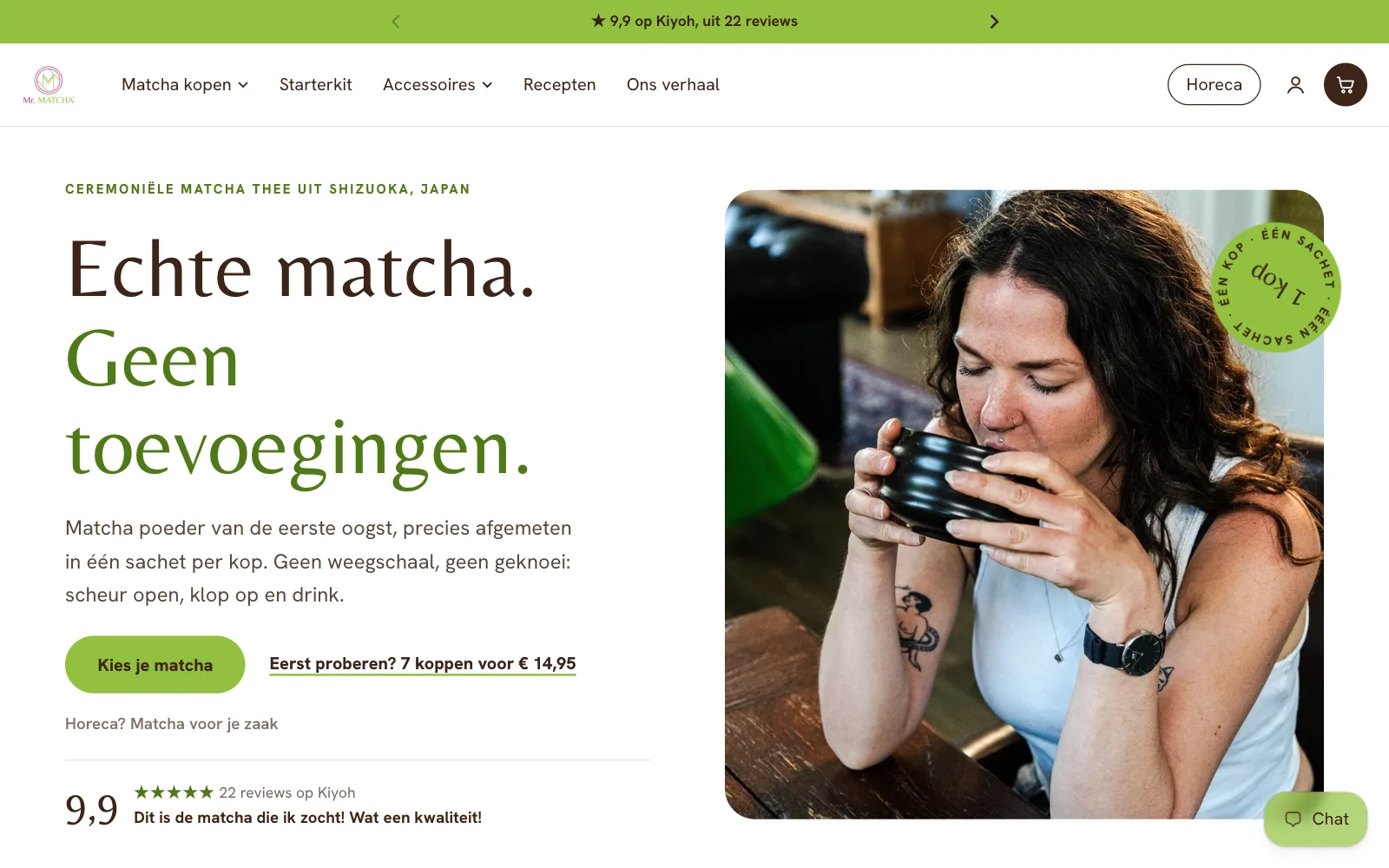
Example 5: matcha
Matcha for home, 30 grams
A fine, bright green powder from Japan. The taste is soft, slightly grassy, with little bitterness. Lovely on its own with water, or as a latte with oat milk.
How to make it: half a teaspoon, about one gram, in a bowl. Add 70 milliliters of water at about 80 degrees Celsius and whisk in a zigzag with a bamboo whisk until it foams. 30 grams makes about thirty cups.
Good to know: matcha naturally contains caffeine. After opening, keep the tin closed, cool and dark, and use it within two months.
Why this works
- Taste comes first. That's what buyers doubt most.
- The number of cups per tin makes the price understandable. A customer works out the price per cup herself.
- There isn't a word about energy, detox or weight loss. Those are health claims, and they're only allowed if they are on the EU list, under the conditions that come with them.

What should you leave out of a product description?
Leave out promises your product isn't allowed to make, and anything that could be copied straight from another site.
- Medical claims. Cosmetics may not "cure" or "treat" anything. Claims about what a cosmetic product does must be honest and backed up. Have the substance checked by your formulator or skin expert.
- The supplier's text. It's already on ten other sites. Google has no reason to pick your page.
- A string of keywords. Use the word people search for in the title, the first sentence and one subheading. You don't need more.
Source: Regulation (EU) No 655/2013 laying down common criteria for claims used in relation to cosmetic products.
How long should a product description be?
As long as it takes to answer the five questions above. For most skincare products that's 100 to 250 words, plus the ingredient list.
Longer isn't better. Someone on a product page wants to know quickly whether the product suits them. The explanation of an ingredient or a routine belongs in a guide, linked from the product page.
Don't start with all your products at once. Check in Google Search Console which product pages already get impressions and rewrite those first. Would you rather have someone else write the copy, read about product copywriting. Then go through the product page checklist. Want to know how I include product pages in a monthly SEO approach, see ecommerce SEO.